Small Business Owner Pays 30,000 Yuan to 14 Million-Follower Influencer—Only 4 Orders Completed
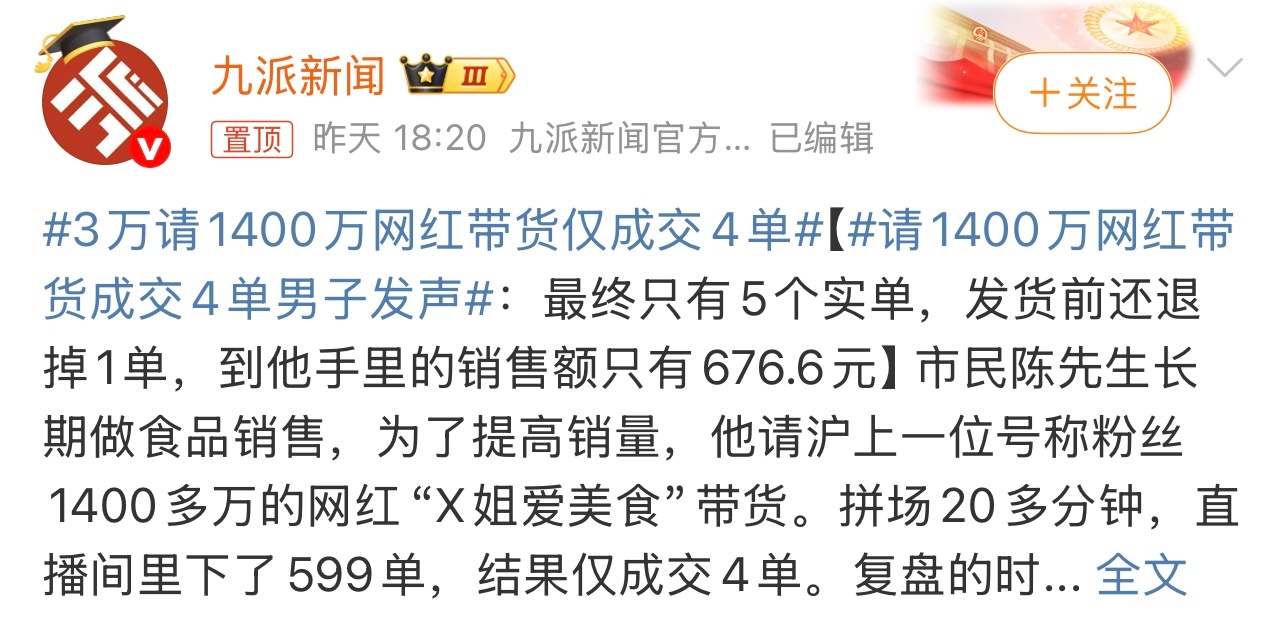
Shanghai small business owner Chen Xiansheng thought he’d struck gold when he paid 30,000 yuan (about $4,200) to a 14 million-follower influencer to promote his food products. But the dream quickly turned into a nightmare: after a 20-minute live stream where the influencer’s fans placed 599 orders, only 4 were actually completed. The rest? Chen alleges they were fake orders—part of a widespread practice of “brushing orders” to inflate sales figures.

8 January 2026
Lead
Shanghai small business owner Chen Xiansheng thought he’d struck gold when he paid 30,000 yuan (about $4,200) to a 14 million-follower influencer to promote his food products. But the dream quickly turned into a nightmare: after a 20-minute live stream where the influencer’s fans placed 599 orders, only 4 were actually completed. The rest? Chen alleges they were fake orders—part of a widespread practice of “brushing orders” to inflate sales figures.
The Story: A 30,000 Yuan Bet Gone Wrong
Chen Xiansheng, a long-time food salesperson in Shanghai, had been looking for ways to boost his sales. Like many small business owners, he turned to the booming world of influencer marketing, hoping that a popular influencer could drive traffic to his products.
His target was a Shanghai-based influencer known as “X Jie Ai Mei Shi” (X Sister Loves Food), who claimed to have over 14 million followers on social media platforms like Douyin (TikTok’s Chinese version) and Weibo.
In July 2023, Chen signed a contract with the influencer’s team, agreeing to pay a 30,000 yuan “package fee” for a live stream. The deal also included a 15% commission for the influencer, which would be deducted from the sales revenue.
The live stream took place on July 20, 2023, and lasted for about 20 minutes. During that time, the influencer’s fans placed a staggering 599 orders for Chen’s food products. Chen was ecstatic—until the reality of the sales started to sink in.
When Chen checked the sales data after the live stream, he was shocked to find that only 4 of the 599 orders had actually been completed. The rest of the orders, he alleges, were never paid for—meaning they were fake orders, or “brushed orders,” as the practice is known in China.
The Allegations: Brushing Orders and Fake Sales
Chen’s shock quickly turned to anger as he began to investigate the 599 orders. What he found, he says, was evidence of widespread刷单 (shuādān)—the practice of creating fake orders to inflate sales figures, which is illegal in China under the Anti-Unfair Competition Law.
According to Chen, the 599 orders were primarily placed by just four users, each of whom placed an unusually large number of orders. For example, one user from Shanghai’s Baoshan District placed 141 orders, while another from Beijing’s Shunyi District placed 165 orders. In total, these four users accounted for 586 of the 599 orders.
Chen alleges that these orders were never intended to be paid for—they were simply a way to make the influencer’s live stream look more successful than it actually was. “This is a classic case of刷单,” Chen told reporters. “They wanted to make it look like the influencer was driving huge sales, but in reality, it was all fake.”
When Chen confronted the influencer’s team about the刷单 allegations, he says he was met with a defensive response. The team allegedly denied any wrongdoing, claiming that the low conversion rate (the percentage of orders that are actually completed) was simply a result of the product’s quality or the influencer’s performance.
However, Chen’s evidence—including the specific user data showing the concentration of orders among a few users—suggests that the刷单 allegations may have merit. If proven true, the influencer and her team could face legal consequences under China’s laws against unfair competition.
Legal and Industry Implications: What This Means for Influencer Marketing
This case has sent shockwaves through China’s influencer marketing industry, highlighting the significant risks that businesses—especially small and medium-sized enterprises (SMEs)—face when investing in influencer partnerships.
For Chen Xiansheng, the financial impact of the failed live stream was severe. After paying the 30,000 yuan package fee and deducting the 15% commission for the influencer, Chen’s actual revenue from the live stream was just 676.6 yuan (about $94). This means that Chen not only failed to make a profit but also lost money on the investment.
The case also raises serious questions about the transparency and accountability of influencer marketing in China. Many businesses rely on influencer partnerships to drive sales, but this case suggests that some influencers may be using deceptive practices—such as刷单—to inflate their apparent success.
If left unchecked, such practices could erode consumer trust in influencer marketing, ultimately harming both businesses and influencers in the long run. For consumers, the risk is that they may be misled into purchasing products that are not as popular or well-received as the influencer’s live stream suggests.
In response to the case, China’s market regulators have taken action. On January 4, 2023, the Baoshan District Market Supervision Administration (a local branch of China’s State Administration for Market Regulation) confirmed that it had launched an investigation into the case. The administration stated that it was looking into whether the influencer’s team had engaged in illegal practices such as刷单.
The investigation is still ongoing, but the case has already prompted calls for stronger regulation of the influencer marketing industry in China. Experts have suggested that regulators should implement more rigorous oversight of influencer partnerships, including requiring influencers to provide detailed sales data and conversion rates to businesses and consumers.
Additionally, the case has highlighted the need for businesses to be more cautious when entering into influencer partnerships. Many businesses, like Chen, may be tempted to invest large sums of money in influencers with massive followings, but this case suggests that follower count alone is not a reliable indicator of an influencer’s actual sales ability.
Businesses should also consider implementing more robust contract terms when working with influencers, such as including clauses that require influencers to provide detailed sales data and to compensate businesses for any losses resulting from deceptive practices. This can help protect businesses from financial losses and hold influencers accountable for their performance.
Furthermore, businesses should think about diversifying their marketing strategies and not relying solely on influencer endorsements. Building genuine customer relationships, optimizing SEO, and leveraging social media content marketing can help businesses create a more sustainable and effective marketing strategy.
Expert Perspectives: Lawyers and Industry Analysts Weigh In
Legal experts and industry analysts have weighed in on the case, offering insights into the legal and business implications of the alleged刷单 practices.
According to Li Da, a lawyer from Dehe Han Tong Law Firm in Shanghai, the case involves three key legal and ethical issues. First, from a legal perspective, the alleged刷单 practices may violate China’s Anti-Unfair Competition Law, which prohibits businesses from engaging in虚假宣传 (xūjiǎ xuānchuán)—false or misleading advertising.
Second, from a consumer protection perspective, the alleged刷单 practices may constitute fraud, as consumers may be misled into purchasing products based on inflated sales figures. If proven, consumers could potentially seek compensation under China’s Consumer Protection Law, which allows for triple damages in cases of fraud.
Third, from a contractual perspective, the influencer’s failure to deliver the promised sales results may constitute a breach of contract. Chen Xiansheng could potentially sue the influencer’s team for damages resulting from the failed live stream.
Industry analysts have also highlighted the broader implications of the case for the influencer marketing industry. Zhang Wei, a senior analyst at iResearch, a leading Chinese market research firm, noted that the case underscores the need for greater transparency and accountability in influencer partnerships.
“Many businesses are still learning the hard way that influencer marketing is not a silver bullet,” Zhang said. “Follower count and flashy live streams can create a false sense of security, but the real test is whether those followers are actually converting into sales.”
Zhang also suggested that businesses should consider diversifying their marketing strategies and not relying solely on influencer endorsements. “Ultimately, the legal and business implications of this case are profound. As China’s market regulators continue to investigate the case, the outcome could have far-reaching implications for how businesses and influencers approach influencer marketing in the future.
In the end, Chen’s story is a cautionary tale for small businesses everywhere: in the fast-paced world of influencer marketing, it’s easy to get caught up in the hype—but the real success comes from building genuine, trustworthy relationships with customers, not just chasing fleeting metrics.
Conclusion: A Cautionary Tale for Small Businesses
In the world of influencer marketing, where follower counts and live stream metrics often dominate the conversation, the case of Chen Xiansheng serves as a stark reminder of the risks that businesses—especially small and medium-sized enterprises—face when investing in influencer partnerships.
Chen’s experience highlights several critical lessons for businesses considering influencer marketing. First, follower count alone is not a reliable indicator of an influencer’s actual sales ability. Businesses should look beyond surface-level metrics and focus on more meaningful indicators of performance, such as conversion rates, customer engagement, and post-purchase feedback.
Second, businesses should implement more robust contract terms when working with influencers, such as including clauses that require influencers to provide detailed sales data and to compensate businesses for any losses resulting from deceptive practices. This can help protect businesses from financial losses and hold influencers accountable for their performance.
Third, businesses should consider diversifying their marketing strategies and not relying solely on influencer endorsements. Building genuine customer relationships, optimizing SEO, and leveraging social media content marketing can help businesses create a more sustainable and effective marketing strategy.
In the end, Chen’s story is a cautionary tale for small businesses everywhere: in the fast-paced world of influencer marketing, it’s easy to get caught up in the hype—but the real success comes from building genuine, trustworthy relationships with customers, not just chasing fleeting metrics.