How a Gold Bracelet Sale by a Minor Unfolded on Chinese Social Media
A dispute over a 22-gram gold bracelet sold by a 16-year-old in Shaanxi province has ignited a fierce debate on Chinese social media, highlighting tensions between parental responsibility, business ethics, and legal accountability. The case, which began in April 2025 when the minor sold the bracelet to a local gold shop for 17,000 yuan, resurfaced nine months later when the parents—aware that gold prices had surged—demanded the bracelet’s return, only to be refused. The ensuing conflict, which involved police and regulatory intervention, has become a flashpoint for discussions about how society should handle transactions involving minors and high-value goods.

28 February 2026
How a Gold Bracelet Sale by a Minor Unfolded on Chinese Social Media
A dispute over a 22-gram gold bracelet sold by a 16-year-old in Shaanxi province has ignited a fierce debate on Chinese social media, highlighting tensions between parental responsibility, business ethics, and legal accountability. The case, which began in April 2025 when the minor sold the bracelet to a local gold shop for 17,000 yuan, resurfaced nine months later when the parents—aware that gold prices had surged—demanded the bracelet’s return, only to be refused. The ensuing conflict, which involved police and regulatory intervention, has become a flashpoint for discussions about how society should handle transactions involving minors and high-value goods.
The Emergence: A Dispute Unfolds
On February 1, 2026, the story broke on Weibo, China’s largest social media platform, when the news outlet 极目新闻 (Jimu News) posted about the dispute. The post detailed how a child had secretly sold a family heirloom gold bracelet to a shop in Jingyang County, Shaanxi, and the parents’ subsequent attempt to recover it. Early reactions focused on the legal validity of the sale: under Chinese law, minors (those under 18) cannot enter into binding contracts for high-value items without parental consent. Many users criticized the gold shop for failing to verify the seller’s age, while others blamed the parents for not supervising their child or securing valuable items.
"This is a classic case of both sides being at fault. The shop didn’t check the ID properly, and the parents didn’t keep an eye on their child. But the parents only came forward when the gold price went up—what if it had gone down?" - Weibo user @深影逸者
The post quickly gained traction, with users sharing their own opinions on who was to blame: the shop for lax procedures, the parents for negligence, or both. Some even questioned whether the parents’ timing was opportunistic, given the surge in gold prices.
The Peak: Official Response and Public Outrage
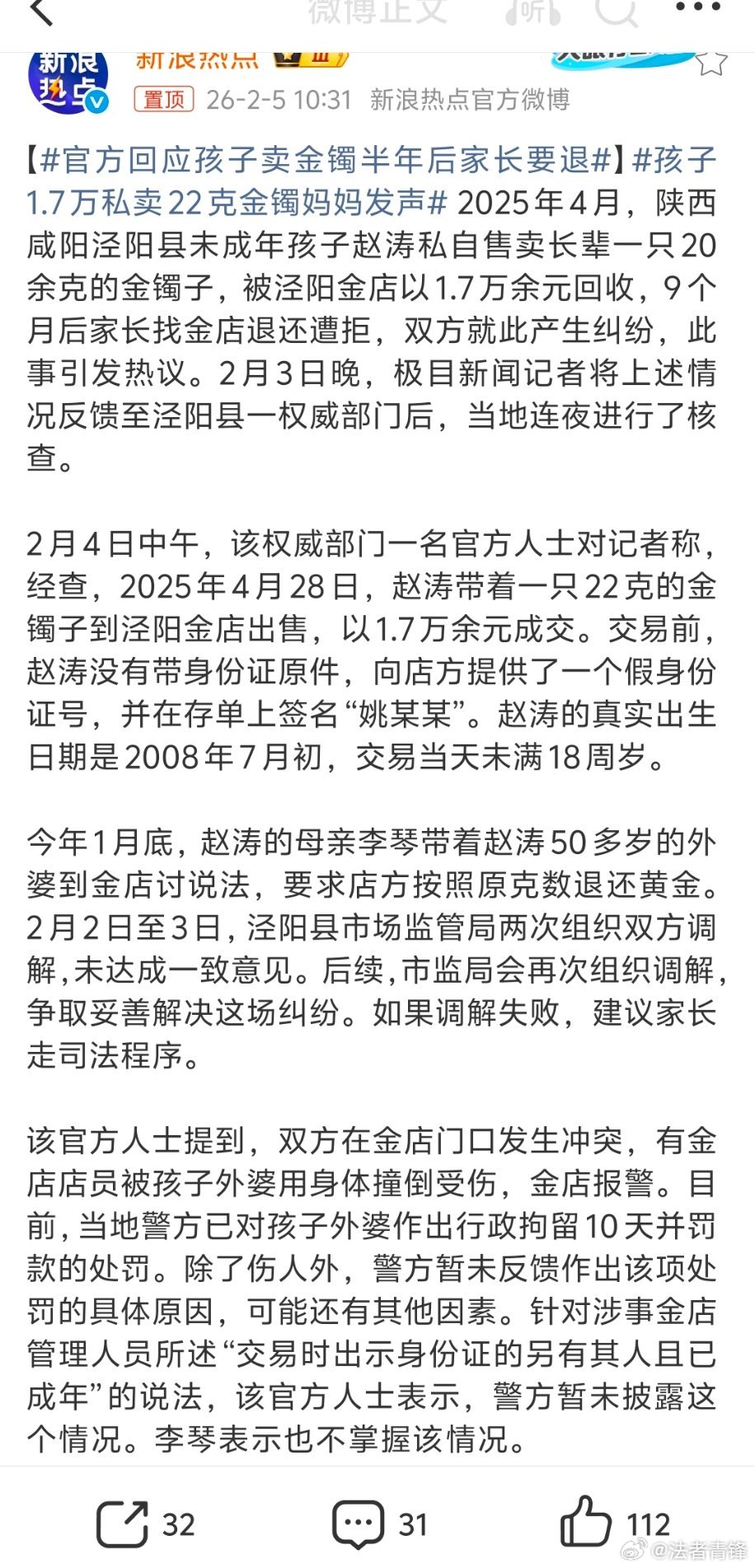
The debate reached its peak on February 4, 2026, when the local government released an official statement. The statement revealed that the minor, Zhao Tao, had used a fake ID to sell the bracelet and that the shop had not properly checked the seller’s identity. Additionally, the grandmother, who accompanied the parents to the shop, was detained for 10 days after a physical altercation with a shop employee. This revelation shifted the narrative: while some continued to blame the shop for lax procedures, others accused the parents of opportunism—arguing they only acted because the gold price had risen from around 700 yuan per gram to over 1,400 yuan.
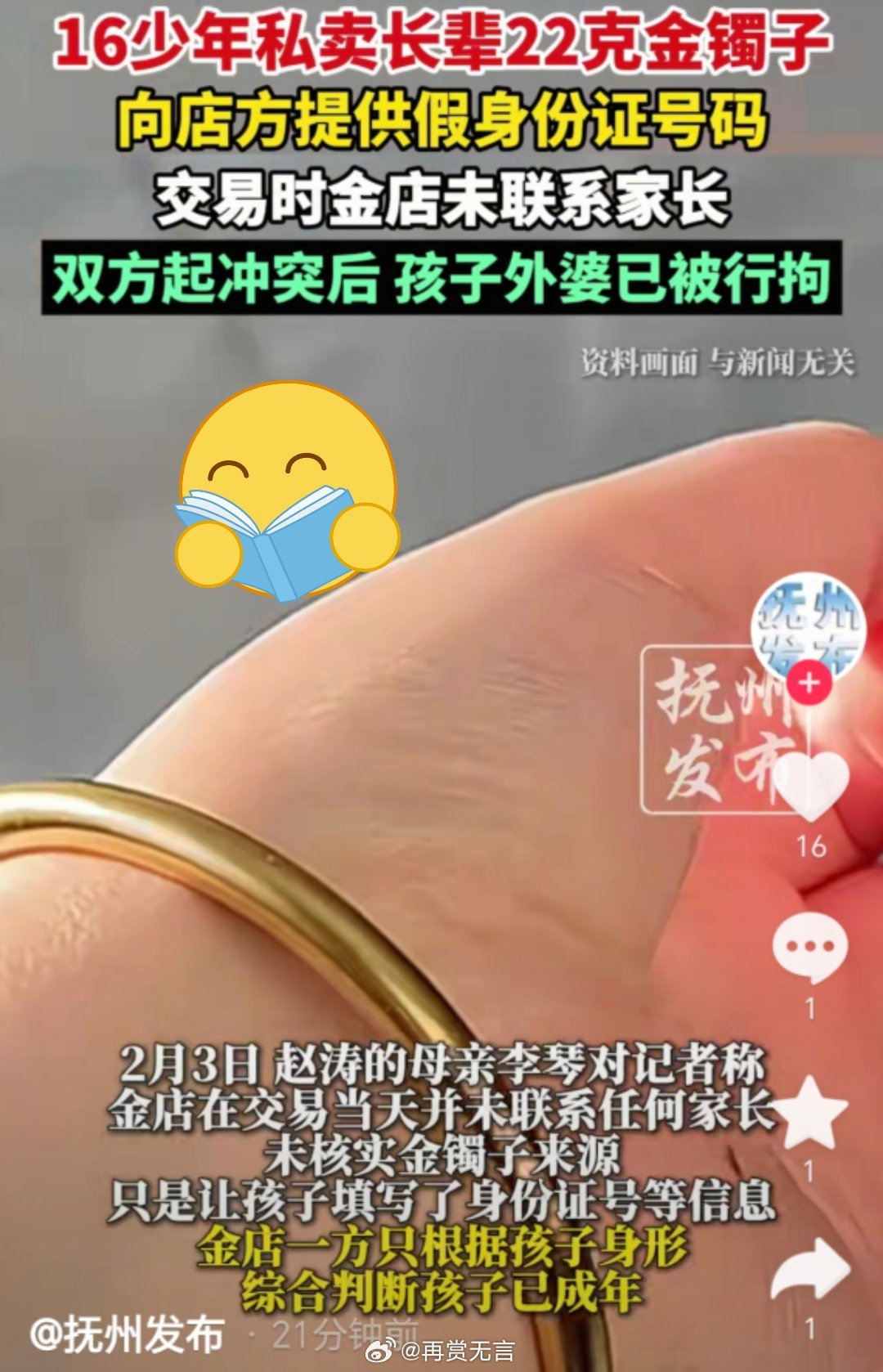
The official response also clarified that the shop had claimed to verify the seller’s ID, but the report contradicted this, noting that Zhao Tao had not presented an original ID and had used a fake number. This inconsistency fueled further criticism of the shop’s practices. As one Weibo user put it: "If the gold price had fallen, would they have bothered to ask for a refund?"

The Aftermath: Legal and Regulatory Implications
In the days following the official statement, the conversation expanded to include calls for better regulation of gold shops and stronger parental education. Legal experts weighed in, noting that the sale was likely invalid under the Civil Code, but that the parents’ delayed action and the shop’s failure to verify identity complicated the case. The market supervision bureau has since organized two mediation sessions, but no agreement has been reached. If mediation fails, the parents may pursue legal action.
"The shop has a responsibility to verify the seller’s age, especially for high-value items. Minors can’t be expected to understand the value of a gold bracelet, so the shop should have asked for a parent’s consent." - Legal expert quoted in Jimu News
The case has also highlighted the role of social media in amplifying such stories. The hashtag #孩子私卖金镯家长半年后想退还遭拒 (Minor sells gold bracelet, parents ask for refund after 9 months and are refused) trended on Weibo, with millions of users engaging in the debate. Some users shared personal stories of similar incidents, while others called for stricter laws to protect both businesses and families.
Key Inflection Points: When the Narrative Shifted
The most significant turning point was the official response on February 4, which provided concrete details about the fake ID and the grandmother’s detention. This transformed the story from a vague dispute into a concrete case with legal and ethical dimensions. It also highlighted the role of social media in amplifying such stories, as the case quickly trended on Weibo and sparked nationwide discussion about the responsibilities of businesses and families.
For now, the dispute remains unresolved, but the conversation it has sparked is likely to have lasting effects. As one Weibo user summed up: "This isn’t just about a gold bracelet—it’s about who is responsible when things go wrong. And that’s a question we all need to answer."
Related Articles

Why Weibo and Xiaohongshu Are Talking About Japan's Deep-Sea Rare Earth—But Saying Very Different Things
By Trending on Weibo
News & Politics
2 Mar 2026
How Iran Nuclear Negotiations Unfolded on Chinese Social Media
By Trending on Weibo
News & Politics
28 Feb 2026
How a Gold Bracelet Sale by a Minor Unfolded on Chinese Social Media
By Trending on Weibo
News & Politics
28 Feb 2026
How a 'Poisoned Baby Cabbage' Scandal Unfolded on Chinese Social Media
By Trending on Weibo
News & Politics
28 Feb 2026

Bill Gates Denies Epstein Allegations as Ex-Wife Melinda Speaks Out
By Trending on Weibo
News & Politics
17 Feb 2026