How Tencent's Yuanbao AI App and Its 10 Billion Yuan Red Packet Campaign Unfolded on Chinese Social Media
In early 2026, Tencent's new AI app Yuanbao launched a massive 10 billion yuan red packet campaign to attract users. The campaign was an instant success, but it quickly backfired when WeChat, also owned by Tencent, blocked Yuanbao's links for violating platform rules against induced sharing. This "internal conflict" exposed the challenges of AI user acquisition, the power of WeChat, and the tensions within China's tech giants.
28 February 2026
How Tencent's Yuanbao AI App and Its 10 Billion Yuan Red Packet Campaign Unfolded on Chinese Social Media
In the weeks leading up to the 2026 Chinese New Year, a digital gold rush swept across China's social media landscape. At the center of it all was Tencent's new AI-powered app, Yuanbao, and its audaciousplan to give away 10 billion yuan ($1.4 billion) in red packets. What began as a massive marketing splash quickly evolved into a public relations crisis, exposing the complex dynamics of China's tech giants and their battle for the future of artificial intelligence.
The Launch: A Billion-Dollar Hype Machine
The story begins on February 1, 2026, when Tencent officially launched its Yuanbao app with a Spring Festival red packet campaign of unprecedented scale. The company committed to distributing 10 billion yuan in digital cash through the app, aiming to attract users to its new AI assistant in a market already crowded with competitors like ByteDance's Doubao and Alibaba's Qianwen.
The campaign was an instant success. Within hours, Yuanbao shot to the top of the Apple App Store's free apps chart, surpassing Doubao. Social media feeds were flooded with posts about the "Yuanbao red packets," with users sharing links and celebrating their winnings. The sheer volume of activity was staggering, with some users reporting receiving hundreds of yuan in a single day.
"腾讯元宝就跟病毒一样,一夜之间席卷各大微信群" - Weibo user
The marketing strategy was simple yet effective: users could earn red packets by completing tasks or sharing links with friends. This "viral growth" model, while common in China's internet ecosystem, would soon become the source of significant controversy.
The Backlash: When the Parent Company Strikes
Just as the campaign reached its peak, a dramatic turn of events unfolded. On February 4, WeChat, Tencent's immensely popular messaging app and the primary channel for sharing Yuanbao links, announced it was blocking access to Yuanbao's red packet links. The official WeChat account, "WeChat Team," issued a statement explaining that Yuanbao's marketing activities were violating platform rules against "induced sharing" and "over-marketing."
The announcement was a bombshell. WeChat's statement accused Yuanbao of using "tasks" and "red packets" to encourage users to frequently share links in WeChat groups, disrupting the platform's ecosystem and negatively impacting user experience.
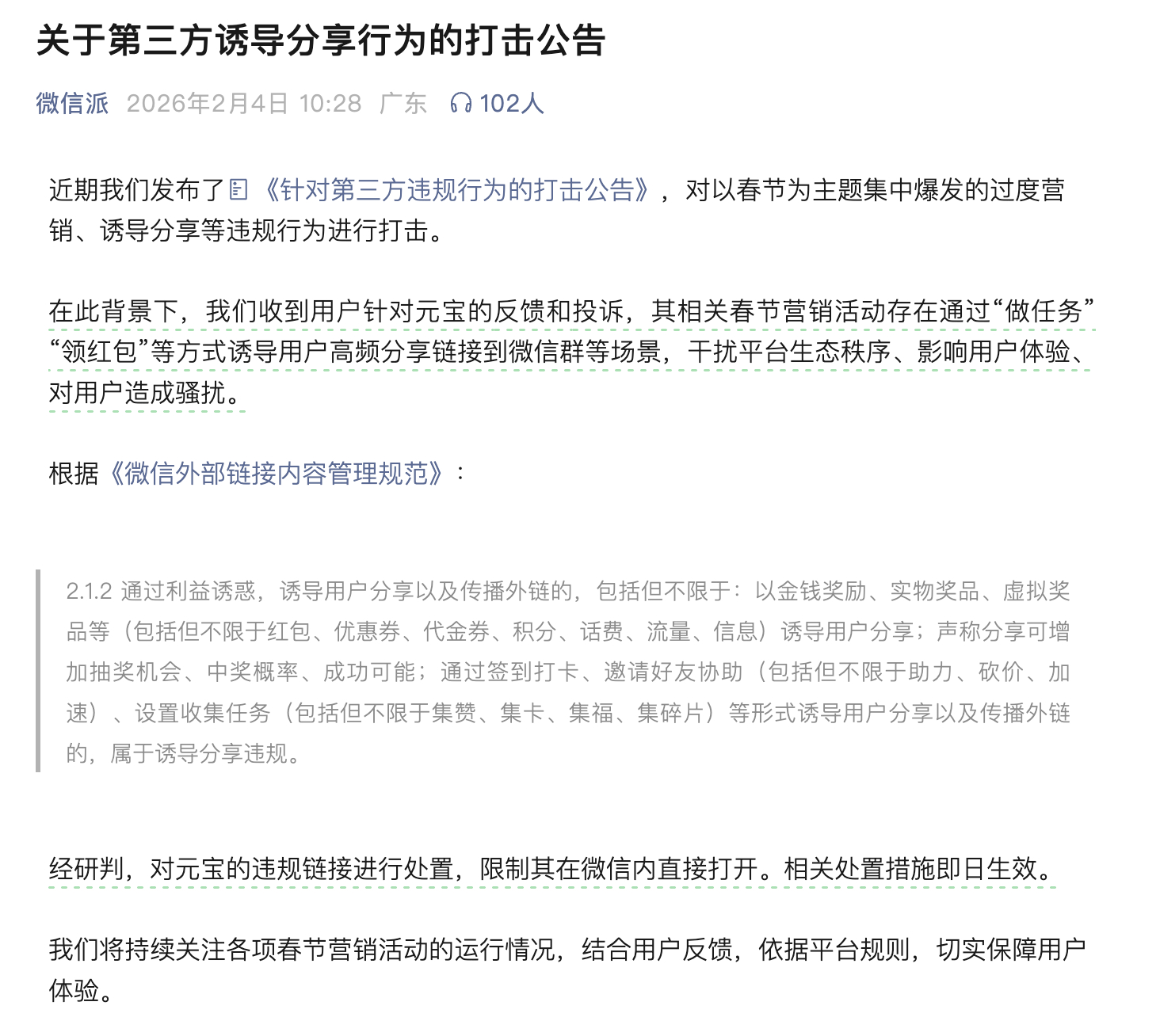
The move was particularly striking because WeChat and Yuanbao are both owned by Tencent. This "internal conflict" sparked widespread discussion about corporate governance, platform policies, and the lengths tech companies will go to in their quest for user growth.
"狠起来连自己人都打,元宝干脆直接植入到微信好了" - Weibo user
Yuanbao quickly responded, announcing that it was "urgently optimizing and adjusting its sharing mechanism" to comply with WeChat's rules. The company shifted its strategy to a "password red packet" system, requiring users to enter a code rather than clicking a direct link.
The Aftermath: What the Crisis Revealed
The Yuanbao incident highlighted several critical issues in China's tech landscape:
- The Power of WeChat: The ability of WeChat to single-handedly derail a major product launch from its parent company demonstrated the immense power of the platform and its role as the gatekeeper of China's digital social space.
- AI User Acquisition Challenges: The crisis exposed the difficulty of acquiring and retaining users for AI products. Yuanbao's heavy reliance on financial incentives suggested that its core product offering might not have been compelling enough on its own.
- Corporate Tensions: The incident revealed the inherent tensions within large tech conglomerates, where different business units may have conflicting priorities and strategies.
- Regulatory and User Experience Priorities: WeChat's actions, while damaging to Yuanbao, were framed as a defense of user experience and platform integrity, reflecting a broader trend of tech platforms cracking down on disruptive marketing tactics.
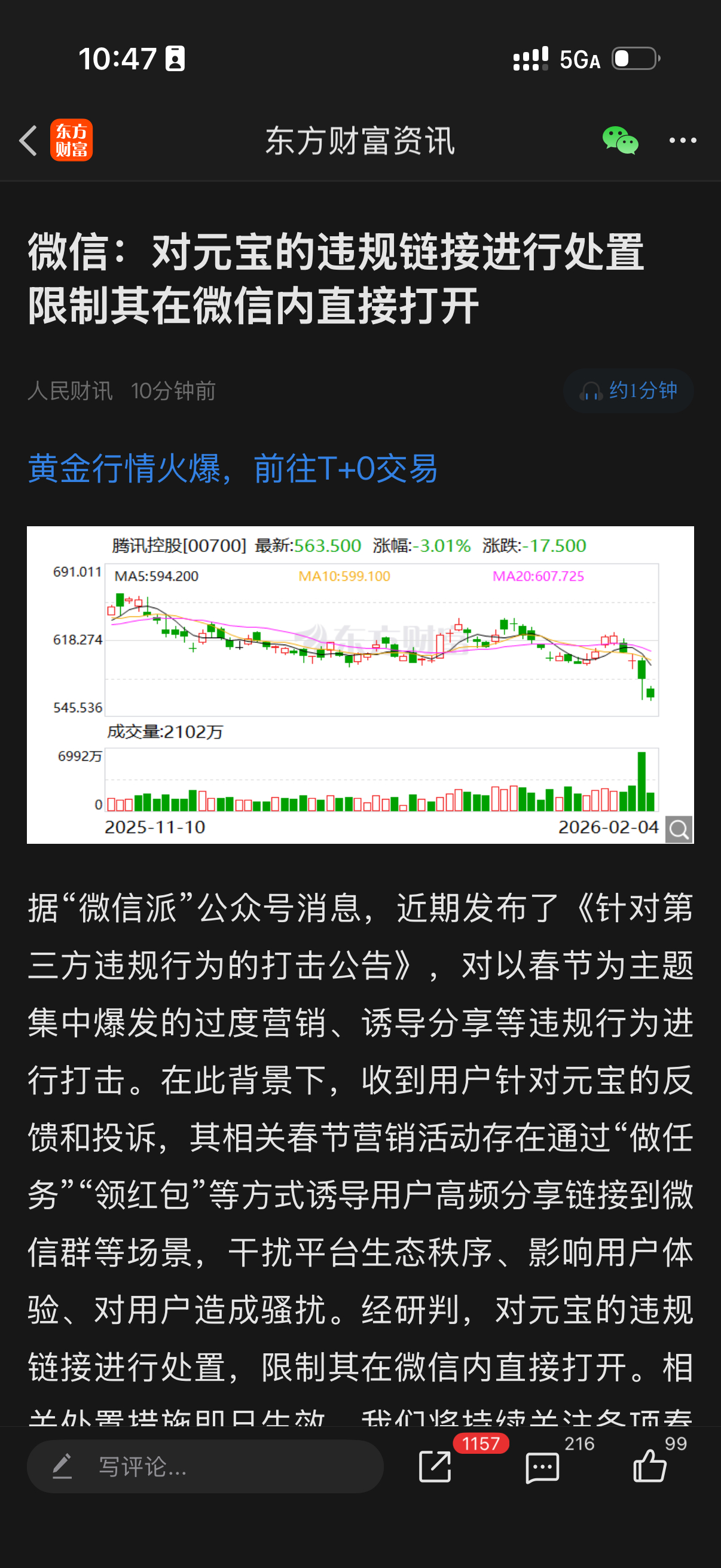
The financial markets reacted negatively to the news, with Tencent's stock experiencing a notable drop following the announcement.
The Bigger Picture: AI and the Future of Tech
Beyond the immediate crisis, the Yuanbao story is part of a larger narrative about the battle for dominance in the AI sector. With billions of dollars being spent on user acquisition, companies are racing to establish their AI assistants as the default interface for the next generation of internet users.
The incident also sparked discussions about the future of digital red packets and their role in marketing. While the traditional red packet is a beloved cultural tradition, its use in aggressive marketing campaigns raises questions about user fatigue and platform sustainability.
As the dust settled, it became clear that the Yuanbao campaign, for all its initial success, had failed to create lasting value. The app's user numbers would likely plummet once the red packet incentives ended, highlighting the ongoing challenge for AI companies to build products that users want to use for more than just handouts.
The story of Yuanbao serves as a cautionary tale for the tech industry: in the rush to capture the future, companies must balance aggressive growth strategies with respect for platform ecosystems and, most importantly, the creation of genuinely useful products.
Related Articles
How 'Little Pony Cakes' Took Over Chinese Social Media During Honor of Kings' Lunar New Year Event
By Trending on Weibo
28 Feb 2026

How Alibaba's Qianwen AI Milk Tea Giveaway Took Over Chinese Social Media
By Trending on Weibo
28 Feb 2026
How Tencent's Yuanbao AI App and Its 10 Billion Yuan Red Packet Campaign Unfolded on Chinese Social Media
By Trending on Weibo
28 Feb 2026
China Achieves Historic Rocket and Spacecraft Recovery in Sea, Marking Major Step Toward Manned Lunar Mission
By Trending on Weibo
17 Feb 2026
Free Milk Tea, Celebrity Endorsement: How Alibaba’s Qianwen AI App Took China by Storm During Chinese New Year
By Trending on Weibo
17 Feb 2026